
There’s a moment, walking through Swarthmore on a weekday morning, when it’s easy to forget you’re just eleven miles from one of the country’s largest cities.
The streets are quiet, the canopy is thick, and the architecture feels deliberately unhurried. Yet within minutes, a train can have you sitting in Center City Philadelphia.
That tension, between small-town calm and big-city access, is precisely what makes Swarthmore one of Delaware County’s most coveted addresses, and it’s a balance very few communities manage to strike.
With just 6,500 residents, Swarthmore punches well above its weight. A median household income of $152,361, nearly double the Pennsylvania state median, and a poverty rate of just 1.8 percent reflect a community that is not only desirable but exceptionally stable.
The median age of 28.3 gives the borough a youthful energy that sets it apart from many of its neighbors, a vitality that traces directly back to the institution that has defined Swarthmore since 1864.
That institution is Swarthmore College, founded by the Religious Society of Friends and today regarded as one of the nation’s premier liberal arts schools. The college didn’t just lend the borough its name; it shaped its entire character.
The emphasis on intellectual curiosity, civic responsibility, and community engagement that Quaker founders instilled more than 160 years ago still permeates daily life in ways both subtle and profound.
For families drawn to that kind of environment, the public schools reinforce it.
The Wallingford-Swarthmore School District serves borough students through Swarthmore-Rutledge School, a top-ranked elementary school right in the borough, and Strath Haven High School in nearby Wallingford, which consistently places among Pennsylvania’s best public high schools.
For commuters, the case for Swarthmore almost makes itself.
The SEPTA Media/Wawa Regional Rail station, situated between downtown and the college campus, delivers riders to Center City in around 30 minutes.
It’s walkable from virtually every neighborhood in the borough, making car-free living not just possible but genuinely practical.
Few suburbs in the Philadelphia region offer this combination of train access and genuine neighborhood character. Most sacrifice one for the other, but Swarthmore hasn’t.
The real estate market reflects that rare status.
Owner-occupied homes carry a median value of $633,800, supported by a housing stock that architecture enthusiasts actively seek out.
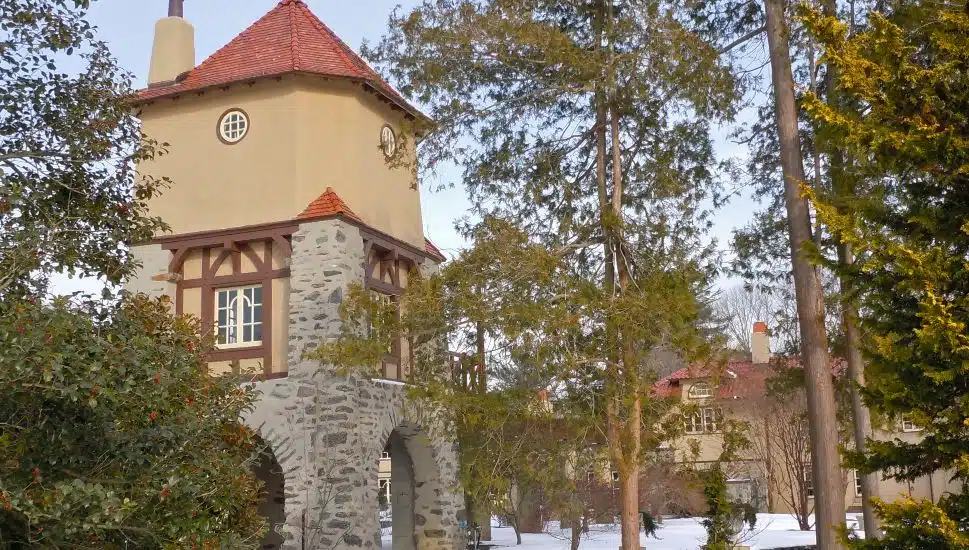
Victorian, Cape Cod-style, and Colonial Revival homes line streets that have changed relatively little in appearance over the past century. With a median home age of around 1948, these are neighborhoods with bones, wide lots, mature trees, deep porches, and the kind of streetscape coherence that simply cannot be manufactured.
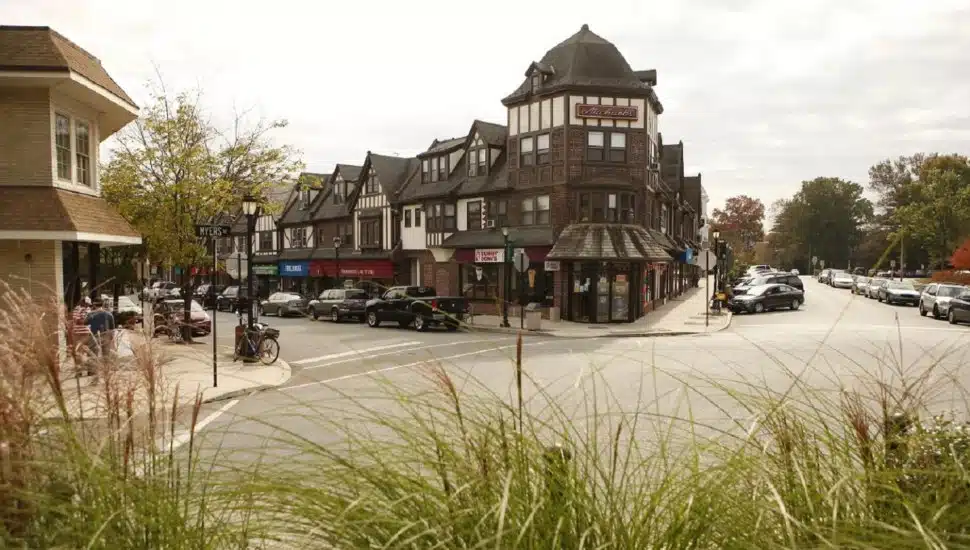
Downtown Swarthmore is small by design and better for it.
Anchored by Park Avenue and Chester Road, the business district is a walkable collection of restaurants, cafés, and shops that have resisted the chain-store homogenization that has flattened so many suburban commercial strips.
Broad Table Tavern, Aria Mediterranean Cuisine, Luna’s Mexican Grill, and Pastry Pants Bakery draw regulars from well beyond the borough’s borders. The Swarthmore Co-op and the weekly Farmers Market keep the community connected to its neighbors and its food in a way that feels increasingly rare.
And then there is Scott Arboretum, 350-plus acres of curated gardens, walking paths, and more than 4,000 varieties of ornamental plants woven throughout the Swarthmore College campus and open to the public every day, free of charge.
For context: this is a world-class botanical resource in the backyard of a borough just 1.4 square miles.
In every season, it’s simply beautiful, and it serves as a daily reminder that Swarthmore offers something that cannot be replicated simply by building more housing or opening more shops.
Swarthmore didn’t happen overnight. It was built slowly, deliberately, and with a clear sense of what a community ought to be, and that, more than any zip code or school ranking, is what people are really buying into when they choose to live here.
_______