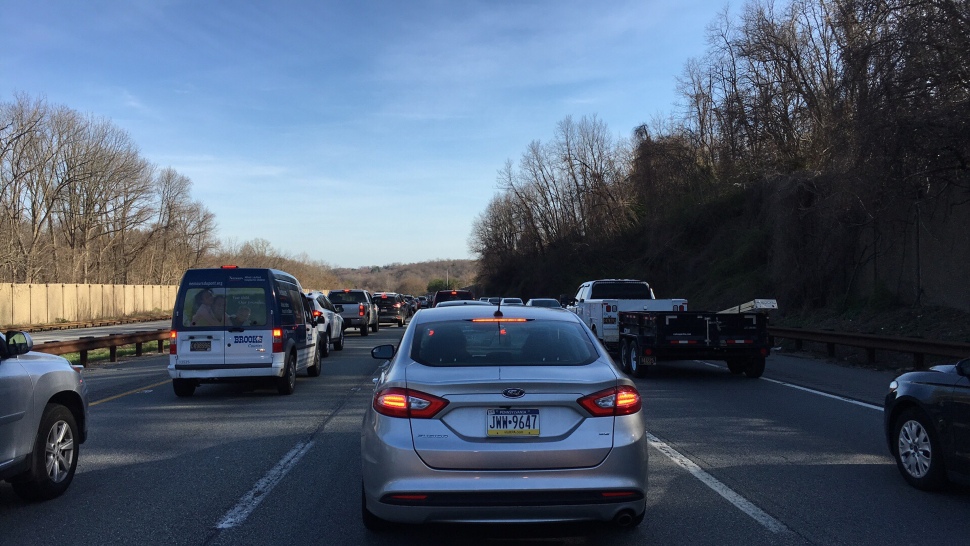

Every day, thousands of drivers cross Delaware County on Interstate 476, known locally as the Blue Route. The highway links Interstate 95 with the Pennsylvania Turnpike and serves as one of the region’s most important north-south corridors.
Few drivers realize the long fight that shaped the highway they use today.
During the 1960s and 1970s, opposition from local residents and from two nearby colleges, Swarthmore College and Bryn Mawr College, played a major role in shaping how the highway was built, especially in the southern part of Delaware County.
The Blue Route Planning and the Crum Creek Alignment
The Blue Route story began in the early years of interstate highway planning.
In the early 1950s, transportation planners began studying possible north-south highway routes through Delaware County and the western suburbs of Philadelphia.
Engineers examined several possible corridors and marked each option in a different color on planning maps.
A 1958 location report identified the preferred alignment. That route appeared in blue on the maps, prompting local officials and residents to call it the Blue Route.
The selected route followed the Crum Creek valley through much of Delaware County.
This alignment was not chosen randomly. Compared with other proposed routes, the Crum Creek corridor required far fewer demolitions.
Planning studies estimated the Blue Route would remove about 165 homes, far fewer than competing routes that passed through denser neighborhoods.
Running through the relatively undeveloped valley made the project less disruptive than other options planners considered.
College and Community Opposition Emerges
Even so, the proposed highway sparked significant and often intense opposition.
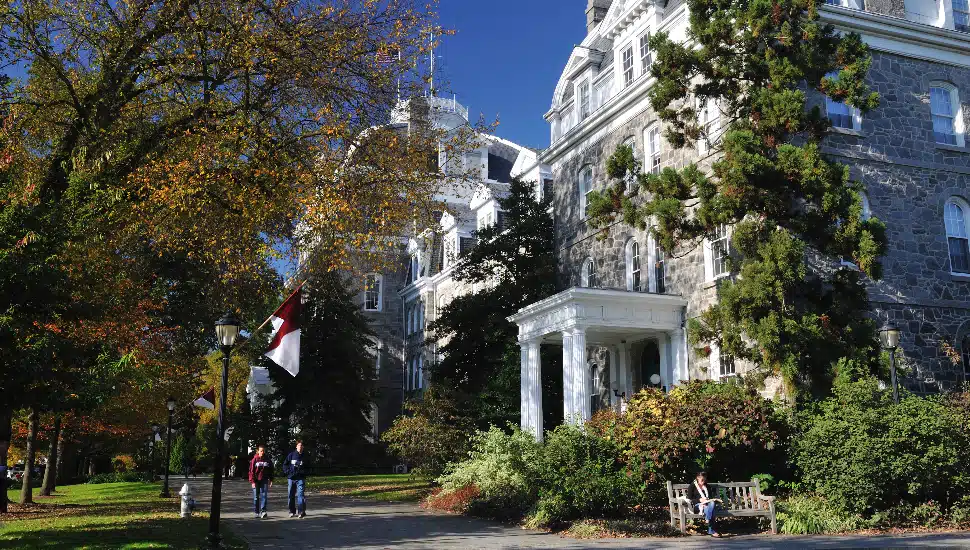
Two nearby colleges became especially active voices in the debate: Swarthmore College and Bryn Mawr College.
Leaders at Swarthmore College raised concerns on two fronts: the potential for the highway to cut directly through campus property, and the broader environmental impact of routing a major highway through the Crum Creek watershed.
Bryn Mawr College joined in opposing the environmental threat to the surrounding natural areas. Faculty members, students, and administrators at both institutions supported research, public discussion, and advocacy focused on protecting the valley.
Their efforts aligned with residents in Swarthmore and nearby communities, including Nether Providence, Springfield, Radnor, and Marple.
Environmental Laws and a Long Planning Battle
The debate intensified during a period when environmental awareness was growing across the country.
New federal environmental laws passed in the late 1960s required government agencies to conduct detailed environmental impact studies before building large infrastructure projects.
Opponents of the Blue Route used these laws to challenge aspects of the project and demand further review.
The result was one of the most protracted highway planning battles in Pennsylvania history.
Construction on the Blue Route began in July 1967. Work began on the northern portion of the highway, and the first completed section, connecting Interstate 76 to Chemical Road in Plymouth Meeting, opened in January 1979.
However, continued legal challenges and redesign efforts delayed completion of the southern sections for many years.
How Opposition Changed the Final Design of the Blue Route
Opposition from colleges, residents, and environmental groups influenced several design decisions along the route.
One of the most visible changes involved the southern portion of the highway. Between I-95 and Route 3, the Blue Route was built with just four lanes, two in each direction, rather than the six lanes originally planned.
This narrower design was the result of a 1985 agreement brokered after a decade of stalled construction, in which environmentalists and highway proponents settled on a parkway concept rather than the very real option of no highway at all.
Additional changes included deeper cuts in certain areas to reduce noise and visual impact, as well as landscaping and environmental protections near streams and wooded areas.
Construction on the remaining sections continued through the 1980s and early 1990s.
The Blue Route through Delaware County, connecting I-95 in Tinicum to the Pennsylvania Turnpike in Plymouth Meeting, was fully opened on December 19, 1991.
The final interchange connecting I-476 to the Pennsylvania Turnpike in Plymouth Meeting was completed in December 1992, finishing the highway in its entirety.
Today, Interstate 476 remains one of the region’s most heavily used highways.
The name Blue Route still reflects the blue line engineers drew on planning maps in 1958.
The road drivers use today also reflects decades of debate. Opposition from Swarthmore College, Bryn Mawr College, and surrounding communities helped shape how the highway was ultimately built, particularly through the environmentally sensitive Crum Creek valley.
_________
Editor’s Note: This post first appeared on DELCO Today in March 2026.