
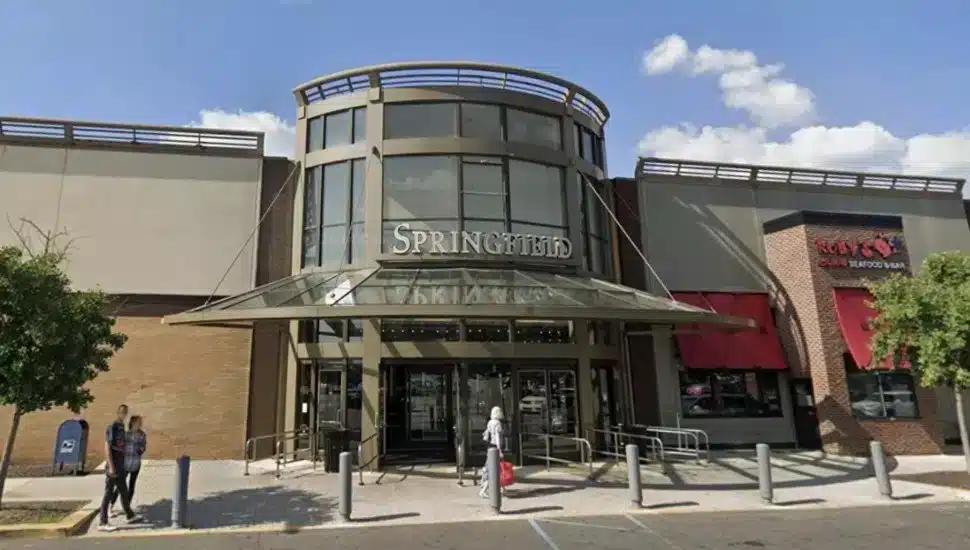
For most of us who grew up in Delaware County, the Springfield Mall isn’t really a building. It’s a feeling.
It’s the smell of the food court on a Saturday. The first paycheck from a first job. The annual pilgrimage for back-to-school sneakers, the holiday crush, the aimless teenage laps with no money and nowhere else to be.
Like every older mall in America, it has changed almost beyond recognition. And yet, for a lot of Delco shoppers, Springfield Mall still glows a little around the edges.
It opened on September 19, 1974, along Baltimore Pike, smack in the golden age of the enclosed suburban mall.
As the county’s second indoor shopping center, it arrived with something to prove.
Stores were held to strict appearance codes, a deliberate pitch to suburban families that they no longer had to drive into Philadelphia to shop somewhere that felt polished and grown-up.
The opening was pure 1970s pageantry.
Shoppers pulled into one of 15,000 parking spaces and were met by Mummers, bagpipers, a chamber ensemble, and a barbershop quartet.
Inside waited two anchors that meant something in 1974: Bamberger’s and John Wanamaker, names that signaled this was a real regional destination, not just a strip of shops with a roof.
And inside, the mall put on a show of its own. There were fountains. A pool. A tropical garden engineered to keep its own indoor weather.
You didn’t come to Springfield Mall to grab one thing and leave. You came to spend the afternoon.
At the center of it all stood a gleaming stainless-steel sculpture, and therein lies the mall’s quietest brush with fame.
The artist was Remo Saraceni, a Philadelphia-area inventor with a gift for turning electronics into play.
Eight years after his sculpture went up in Springfield, Saraceni built the Walking Piano, the enormous, foot-played keyboard Tom Hanks dances across in the hit 1988 film Big.
That original found a home at the Please Touch Museum in Philadelphia.
Saraceni stayed close to home to the end, dying in 2024 in Swarthmore, a few towns from the mall his work found a home in.
The man who greeted Delco’s first Springfield shoppers with a piece of kinetic art went on to create one of the most beloved props in movie history.
The anchor stores, meanwhile, quietly charted the entire history of American retail.
Bamberger’s became Macy’s in 1986. John Wanamaker closed in 1995, briefly became Hecht’s, then turned into Strawbridge’s by 1997.
Each name marked a different chapter back when a department store could set the rhythm of a family’s weekends and holidays.
Ask longtime residents which stores they remember most, and the answers spill out like a time capsule cracking open: Strawbridge’s. Wanamaker’s. Sam Goody. Waldenbooks. The Disney Store. The food court regulars. The bustle that made the place feel alive.
Then the world changed, and Springfield Mall changed with it.
Online shopping, department-store mergers and shifting tastes pulled the center of gravity away from malls like this one.
Nowhere was that clearer than on the old Strawbridge’s site.
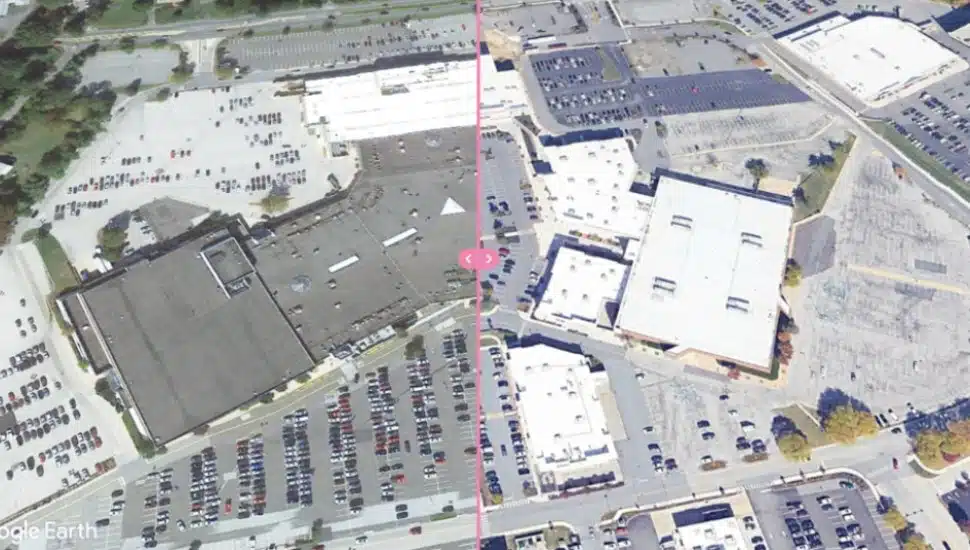
The store closed in 2006. The building came down in the fall of 2008. And in its footprint rose a brand-new Target, opening October 11, 2009.
The mall was no longer organized around a grand department store. It was organized around an errand.
You can feel it in the atmosphere today.
Less wandering, more purpose: groceries, beauty products, a gift, a new pair of shoes, a quick bite.
Macy’s and Target still anchor the building, joined by familiar popular names like Ulta, LOFT, American Eagle, Windsor, KAY Jewelers, Build-A-Bear, Bath & Body Works, and Yankee Candle.
The money tells the starkest story of all.
In 2005, PREIT and Kravco Simon bought the mall for $103.5 million, a confident bet on its future.
Two decades later, owners PREIT and Simon Property Group recently let a $32.4 million loan on the mall’s interior sail past its maturity date.
A property that once traded for nine figures is now straining under a debt a fraction of that size.
Still, the Springfield Mall hasn’t vanished from Delco life.
It may never again be the fountain-filled showplace so many residents remember. But the real story was never about the stores that came and went.
It’s about how one familiar landmark kept changing alongside the county around it, and what that missed payment hints about the future still being written.
_______