


Students at Widener University received some unique training recently from a former U.S. Marine.
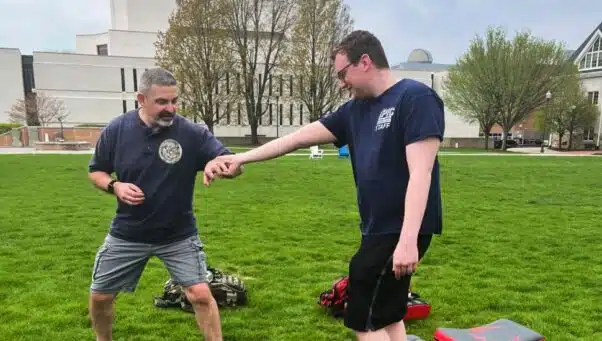
The free workshop on April 19 taught the students self-defense techniques that could be used against a combative patient.
The session took place on Widener’s Chester campus and involved about 15 nursing students.
Most of the attendees were sophomores or juniors starting their clinical rounds, which will likely be the first time they will be working with patients.
They were led by Samuel Flood, president of the Widener University chapter of the American Association for Men in Nursing. First chartered in 2012, Widener’s chapter aims to influence the practice, education, research, and leadership for men in nursing and advance men’s health.
“Our Widener chapter has a long history of engaging with the campus and surrounding community to promote healthy living and provide our members with the experiences and tools to make meaningful change in the healthcare industry,” said Normajean Colby, associate professor of nursing and Widener chapter founder.
“Events like this workshop enable the organization to connect with students across the university and teach important skills that can be applied by both nursing and non-nursing students,” Colby added.
Flood, an undergraduate nursing student at Widener University, spent four years in the USMC infantry, excelling as a specialized anti-tank missile gunner.
He offered martial arts skills and techniques for nurses who may find themselves in real-world situations with patients who suddenly become aggressive or violent.
He was joined by instructor Rob Kloss, co-owner of Cornerstone Martial Arts in Hockessin, Delaware. Kloss is a celebrated marital artist and an active firefighter/EMT with the West Grove Fire Company in Chester County and serves with the county’s Critical Incident Stress Management Team.
The self-defense sessions also demonstrated to the nurses how to de-escalate tense situations, helping to put patients at ease.
“So I’m dealing with a lot of non-lethal techniques that wouldn’t harm the patients, but we keep you out of harm’s way and de-escalate the situation,” Flood said.
Nurses are at high risk for assaults and violence in the workplace. The American Nurses Association reported in 2021 that two nurses per hour are assaulted by a patient in an acute care setting.
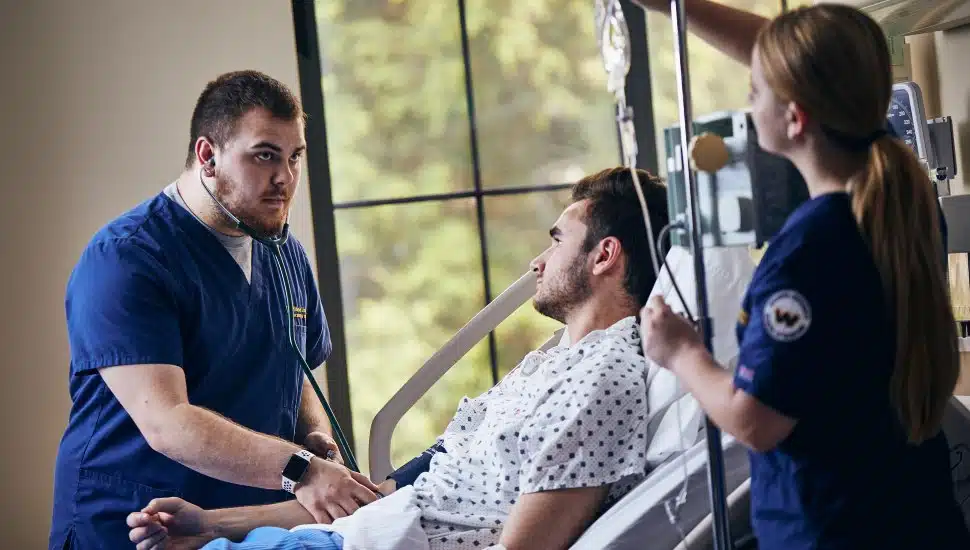
The workshop ran scenarios while students practiced martial arts movements under the guidance of Flood and certified black-belt instructors.
As a Marine, Flood was deployed in Japan on a naval warship based in the Mediterranean and was briefly outside of Ukraine shortly after Russia invaded in 2022.
After military service, he worked as an EMT, which eventually led him to Widener’s nursing program.
“When I was on the ambulance I never had more fun doing anything in my whole life. I just loved practicing medicine,” he said.
He’s now pursuing a career as a flight nurse.
In his role on campus as president of the AAMN Widener chapter, he’s been able to organize hands-on events like the self-defense workshop to help Widener students.
A lot of times, attacks on nurses and paramedics are triggered by patients under the influence of drugs like PCP, he said.
The patient is in an altered state of mind, and they get aggravated. Also, if they are in a highly traumatic situation physically, their mental state is going to be out of whack, Flood explained.
There are also situations where patients cannot speak for themselves, so family members will sometimes get aggressive.
While you’re providing interventions to save a patient’s life, a family member may not understand what’s going on.
“They just see a scary situation and might grab the nurse,” Flood said.
He said it’s hard in the beginning for nurses to get into the mindset that they may have to defend themselves.
“In a profession where you’re conditioned to do no harm, it’s difficult to get into the mindset of having to defend yourself physically,” he said.
He hopes that future self-defense workshops can offer more in-depth instruction after this first introductory session.
The workshops are not officially part of the nursing curriculum at Widener but are offered to students as an extracurricular or club activity.
Flood urges anyone pursuing a nursing career to learn these self-defense skills, even if they aren’t part of a curriculum that earns them a certificate right now.