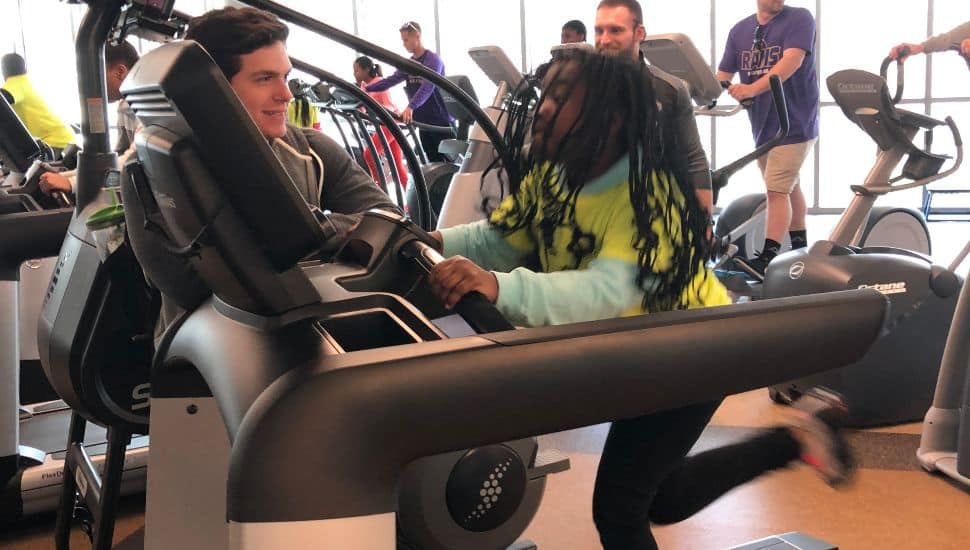

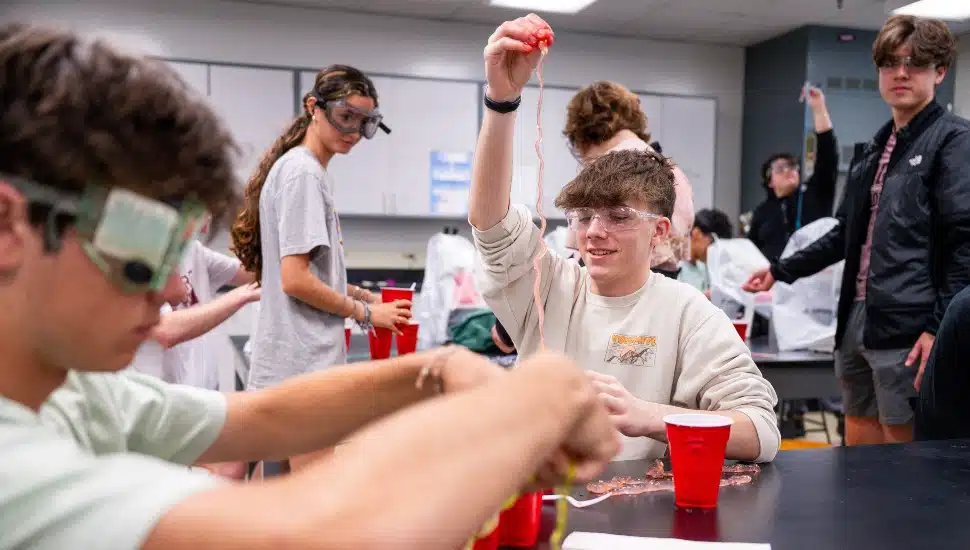
A group of 9th and 10th graders from Oxford Area High School spent time on April 24 hooked up to sensors in a West Chester University physics lab, experimenting with electrical physiology.
The students used the electrical currents generated by muscle movements to play Super Mario Bros., control a claw to build a cup tower, and create involuntary muscle contractions in their classmates.
“I thought it was really cool how you could control someone else’s arm from your arm. That was really cool, and I did not know you could do that,” commented 10th-grader Jaelyn Greene.
Sophomore Chloe Sisson said the experiments were different than anything she’s done before, more interactive, and more interesting than what she was expecting.
For West Chester University engineering and physics professor Dr. Brandon Mitchell, it was music to his ears.
Dr. Mitchell is director of outreach and access for the WCU Center for STEM Inclusion, which is collaborating with Deloitte’s Smart Factory Believers program and Heights Philadelphia to empower Pennsylvania’s kindergarten through 12th-grade students to pursue fields in science, technology, engineering, and mathematics (STEM).
The idea is to expose the students to experiences and equipment they wouldn’t normally receive in a typical school setting, especially at schools that don’t have a lot of resources, which are prioritized for the program.
West Chester University also serves as an educational hub to train public middle school and high school teachers to expand the program in local schools.
In total, 45 Oxford Area high school students participated on April 24. In addition to the physics experiments, students spent time experimenting in the chemistry labs.
The students worked in the university’s Science Complex South and Sciences and Engineering Center & The Commons.
The hope is that by showing the students real-world applications of science and technology through fun experiences and experiments, they might start down a path toward a possible STEM career.
“They’re excited about stuff,” Dr. Mitchell said. “You go into a fourth-grade classroom in the inner city where there is nothing. You bring in some stuff, and they’re fascinated before I even do anything.”
The problem is the kids usually don’t have families or anyone around to show them what a career in STEM looks like.
Parents are less likely to have engineering jobs or chemistry jobs. A lot of the students have parents that never went to college.
Dr. Mitchell’s program, now in its fourth year, brings in industry partners to talk and work with the kids about STEM careers.
Besides the experiments last Thursday, Oxford students heard from a representative from Arkema Chemical about material science and chemical analysis, which could lead to building parts for airplanes. A du Pont representative talked to them about manufacturing, while Ventana System demonstrated 3D modeling, creating a virtual building to look at heat flow.
“What it really comes down to is giving them a sense of what modern science is,” Dr. Mitchell said.
Oxford Area High School Principal James Canaday said he met Dr. Mitchell through the school district’s superintendent Dr. David A. Woods and liked the idea of the students participating in his program.
“Our district is really, really pushing STEM education for students. It starts in our elementary schools all the way up through high school,” Canaday said.
This was their first opportunity to work with West Chester University and Dr. Mitchell, “so that’s why I came up just to see what this was all about.”
The school district hopes to bring the students back next year.
“Any time you can get high school students on a college campus, just checking out the school and seeing what college is about, and then getting to take part in some STEM labs is a good thing,” Canaday said.
A big incentive for school districts to participate is West Chester University’s ability to work with industrial partners and utilize grants to provide the experiences at no cost.
This year, the university was able to bring in 18 schools covering the region from Kennett Square to the city of Philadelphia.
It can be an expensive endeavor many districts can’t afford—up to $1,200 per student per day, Dr. Mitchell explained, when you add up busing costs, meals, and supplies.
The STEM workforce development workshops initially started as a way to recruit high school students to come to West Chester University, but after talking with school district officials about gaps in student’s experience with science, the focus shifted toward getting the community engaged in science and exposing students to the jobs that are out there, Dr. Mitchell said.
“We never tell the students to come to West Chester. We never tell the students it’s so great here. We just have them come here and have a good time, and if that changes their mind to come here, that’s great.”
It became more about the university leading the way to expose students to STEM possibilities.
It’s also about filling an industry need to have an educated technology-based workforce, whether that’s welding airplanes for Boeing, or becoming an organic chemist.
Dr. Mitchell’s efforts are working. He’s seeing interested students coming back each year to the program and asking questions about what classes to take when they go to college.
Other students are starting STEM activities, like a robotics club, at their own high schools.
“Students know us. They remember us and, most importantly, they’re embracing STEM,” Dr. Mitchell said.