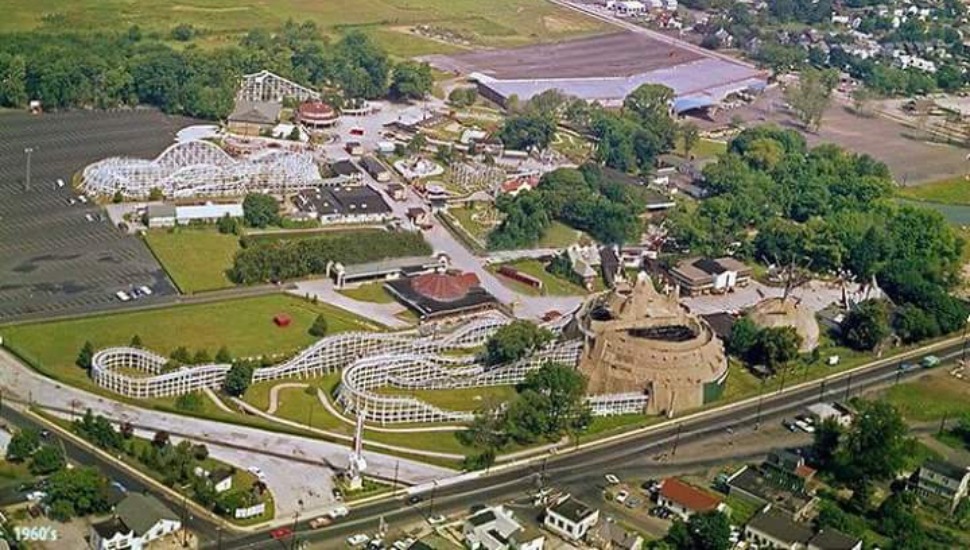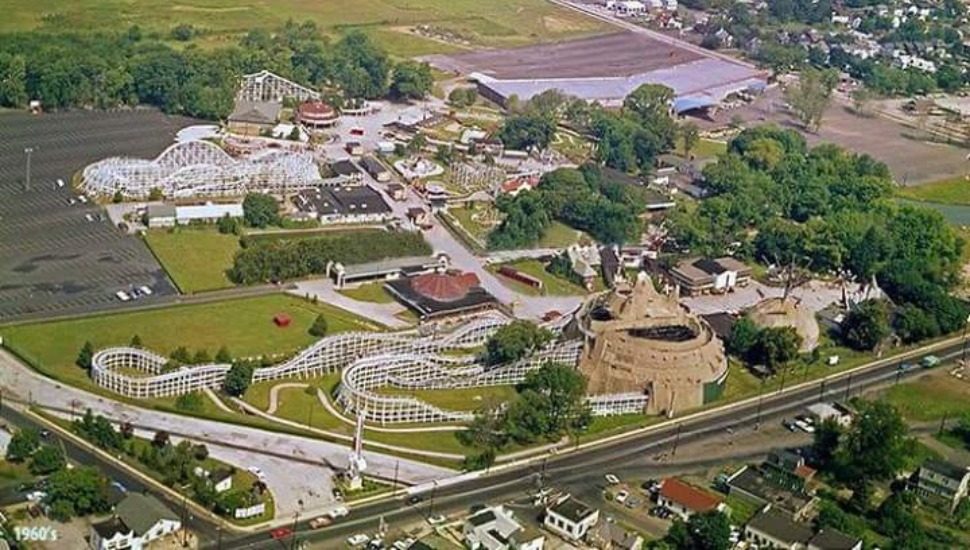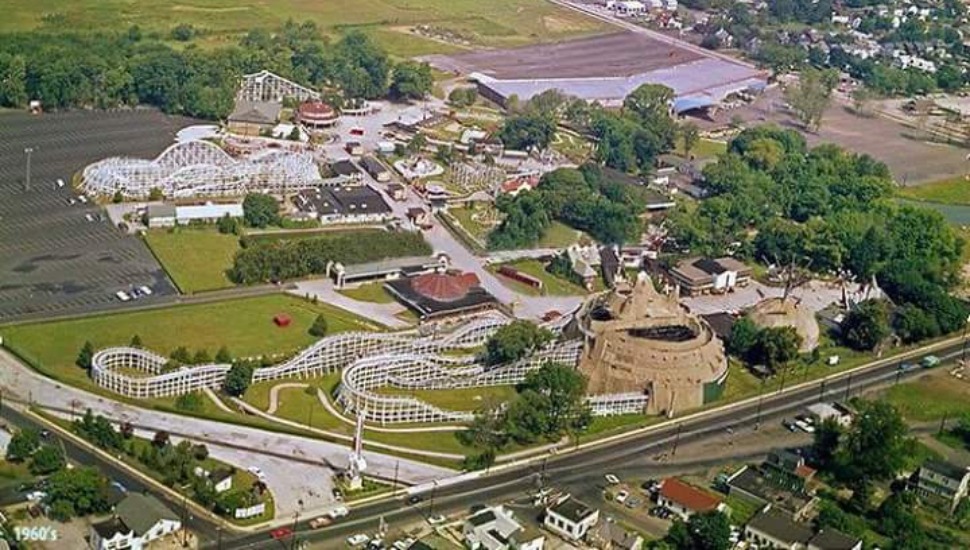

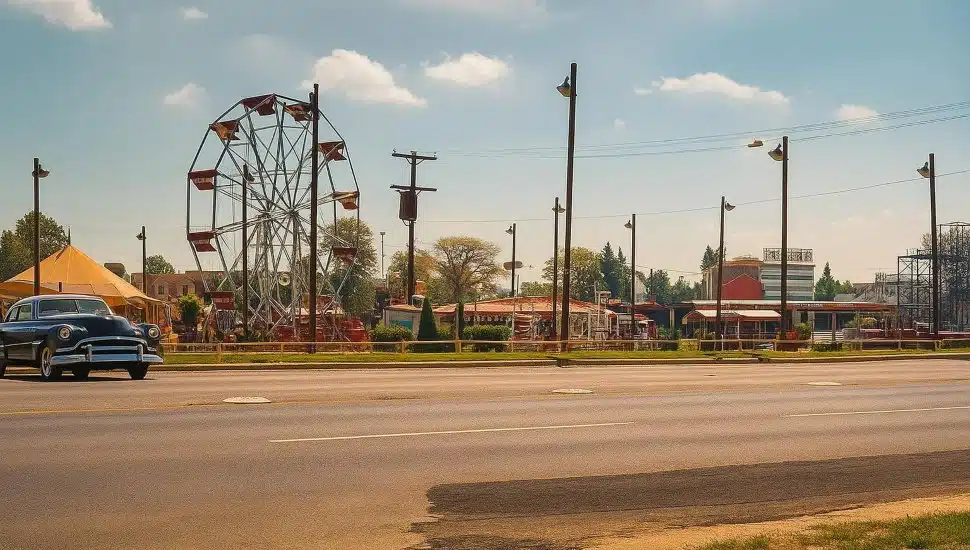
Today it’s a Kohl’s, a parking lot, and the steady hum of Baltimore Pike traffic.
Pull in for towels, or a return, and nothing on that asphalt hints at the Ferris wheel, roller coasters, Skee-Ball lanes, carousel, and concession stands that used to stand there.
This was Playtown Park.
What Playtown Park Was, and Where It Stood
For Delco kids who grew up in the 1950s and 1960s, Playtown was not Hersheypark and never tried to be.
It was smaller, closer, and easier, which was exactly the point.
It sat right on Baltimore Pike, near the Springfield and Morton line, in the area most people now picture as the Kohl’s property.
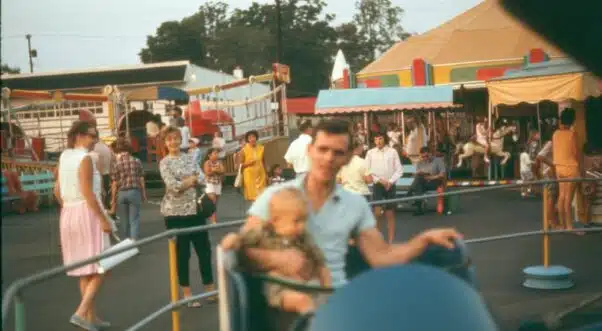
You didn’t need a road trip for some family fun. You just needed a lift from your parents and a couple of dollars for ride tickets.
It also sat on one of Delco’s most storied roads.
That run of Baltimore Pike earned the nickname the Golden Mile as car dealerships, restaurants, and shops crowded in, and the automobile remade the suburbs.
Playtown was one of its brightest stops, which is part of why it still surfaces in local memory alongside survivors like Charlie’s Hamburgers.
The Rides That Made Playtown Park
The park turned an ordinary commercial strip into a child-sized carnival.
Families remember the kiddie rides, the Tilt-A-Whirl, the miniature railway, the bumper cars, and the helicopter-style Whirlybird that let small pilots feel like they were really flying.
There were two coasters for young visitors to enjoy, depending on how daring they were.
The Little Dipper was a gentle kiddie ride, while the Wild Mouse was a small steel thrill coaster built for the bigger kids. Both were sources of constant fun.
Grandeur was never the appeal.
The draw was arcade games, prize games, Skee-Ball, miniature golf, and enough bright lights and tickets to make Baltimore Pike feel like a carnival.
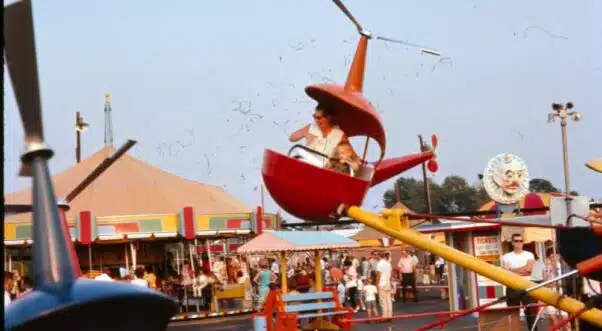
The park ran on a model that now sounds almost unthinkable.
Admission was remembered as free. Families paid as they went: a few tickets for the rides, a bit more for a game or a round of mini-golf, and something for food.
Visitors mention cheap ride tickets, coupons, and special deals.
Others remember meeting local celebrity TV personality Sally Starr, known for her time hosting the Popeye Theater from the 1950s to the 1970s, during their trips to the park.
Some recall the concession stand, the bags of peanuts, the hot dogs, and the small ceremony of grabbing something to eat before heading back for one more loop.
For a lot of Delco families, Playtown was less a place than a ritual.
Even to this day, memories linger of feeding peanuts to the squirrels, the slow turn of the carousel, or a round of mini-golf played under the watch of the park’s strangest surviving legend.
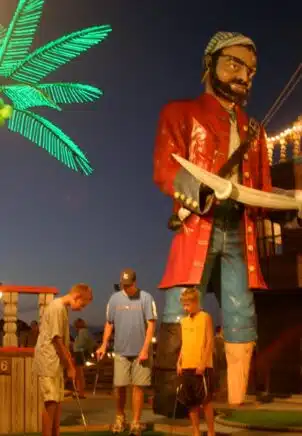
That would be the giant pirate.
The Pirate That Outlived the Park
A towering fiberglass pirate once stood guard at Playtown, the kind of roadside giant that made kids press their faces to the car window.
When the park closed in the late 1960s, the pirate didn’t head for a landfill.
It went to auction, where it was bought by Scott Simpson, owner of Playland’s Castaway Cove, and his father.
Today it stands at Golden Galleon Pirate Golf, a pirate-themed mini-golf course in Ocean City, New Jersey. A piece of Baltimore Pike that washed up at the Shore and never left.
What Happened to Playtown Park
There is no single, tidy reason the park vanished.
The likely story is the one that erased countless small roadside attractions. The land got too valuable to leave to a carousel.
The Golden Mile leaned harder into shopping, and Playtown faded from that stretch of road.
A Clover store later took over the space before the corner settled into the Kohl’s that anchors it now.
Drive that block today, and you would never guess what it once held.
There’s no marquee, no plaque, no hint that the same patch of Baltimore Pike was once home to the rides, arcade games, and the pirate keeping watch over all of it.
Playtown Park might be gone, but in Delco memory, its legacy as a fun family spot persists.
_______