


In the pre-dawn hours, cadets of the Reserve Officers’ Training Corps (ROTC) Dauntless Battalion are hard at work doing push-ups, pull-ups, and other intense physical training in the campus field house as their fellow Widener University students sleep.
It’s a ritual they’ll repeat four times a week, writes Hilary Bentman, director of social media; and Nicole Carrera, assistant director of communications for Widener University in Chester.
The training will be followed up by breakfast in the Pride Café.
The cadets attend classes in their majors like other Widener students, but they’ll also be exposed to military science classes and hands-on labs each week, studying topics that include ethics and morality and basic infantry skills.
“As a cadre, academics is hugely important to us,” said Lt. Col. James Pascoe, who leads the Dauntless Battalion and serves as professor of military science. “To be an officer you have to get a degree, and we work one-on-one with our cadets to make sure their academics are on track.”
Leadership training is the beating heart of ROTC and it’s the cadets who run the battalion.
Dauntless Battalion cadets commit eight to 10 hours a week to the program – balancing their civilian lives and responsibilities.
Those who complete the ROTC program will commission as second lieutenants in the U.S. Army and pursue careers in various fields, from combat roles to nursing to engineering, and more.
Today’s ROTC program is descended from Widener’s earlier days when it was a military college. It carries on a time-honored tradition more than two centuries in the making.
About 500 or more cadets since 1972 have commissioned into the U.S. Army from Widener’s program.
Though ROTC at Widener technically dates back to the 1860s, the modern program was established with the signing of the National Defense Act of 1916.
Widener, known then as Pennsylvania Military College, was one of the first groups of schools to institute an ROTC program on campus, where it remained.
When the university became Widener College in 1972, a civilian ROTC program was launched and quickly became a success..
Within two months from its start, Widener College had two ROTC cadets named the top cadets at the U.S. Army 1972 Advanced ROTC Camp.
In 1978, the program saw its first three female commissioned officers – Patricia Dixon, Susan Turley, and Kim Terrell.
Widener’s ROTC program can also lay claim to having possibly the longest continually manned professor of military science in the nation.
Dauntless Battalion, comprised of four companies, serves as home to cadets from a number of area schools in addition to Widener, including Neumann University, Penn State Abington and Brandywine campuses, Villanova University, West Chester University, Cheyney University, and Immaculata University.
The camaraderie among cadets continues values instilled during the days of the Pennsylvania Military College.
Meghan Rampolla, a class of 2025 nursing major, was attracted to the camaraderie even before enrolling at Widener. Her grandfather, Bob Hawley, a 1962 PMC graduate, shared stories about the brotherhood of the corps, counting his fellow cadets among his lifelong best friends.
With a scholarship in hand and an athletic disposition, Rampolla enrolled in ROTC.
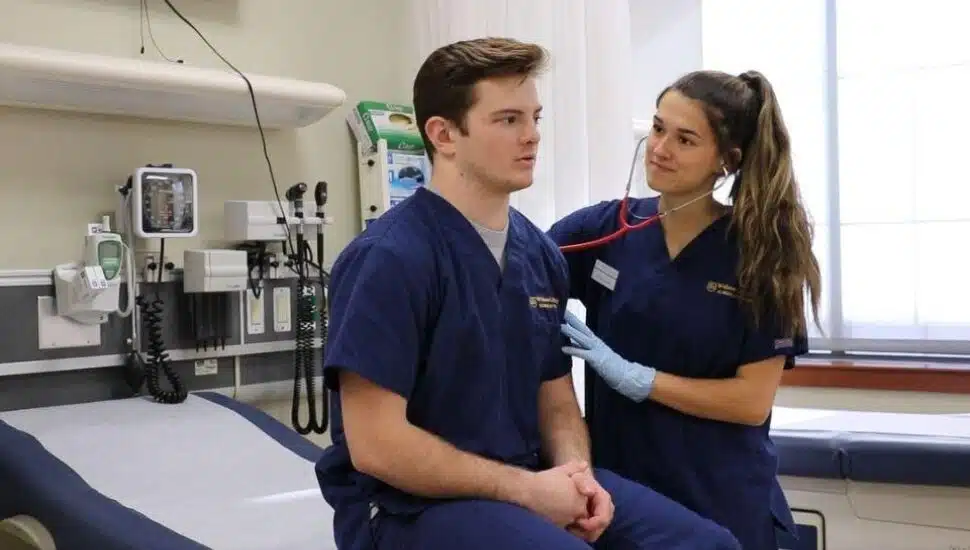
She now holds the current position as cadet first sergeant – and has used her leadership skills in her academic life, as well as in preparing for a career as an active-duty nurse.
Rampolla spent part of summer 2024 at Walter Reed National Military Medical Center in Bethesda, Maryland, shadowing staff nurses on 12-hour shifts.
“It was one of the best experiences. It was the first time feeling like a real nurse,” said Rampolla.
Her fiancé, Lt. Kevin Draeger, graduated and commissioned from Widener in 2024.
“ROTC brought us together and our plans and goals are aligned,” said Draeger, who studied biomedical engineering at Widener and serves as an active-duty medical services officer in North Carolina.
Draeger’s grandfather is also a PMC alum and the groomsman in his upcoming wedding are Widener cadets he commissioned with.
Widener cadet Darryl Villard ’25 studies robotics engineering and works for the university’s Information Technology Services department.
When he commissions in May, Villard will join the National Guard and hopes to pursue a career with the Signal Corps.
Villard says ROTC has helped him find his voice.
“People here encourage me. ROTC has increased my confidence. I’m getting better at planning and teamwork,” he said.