
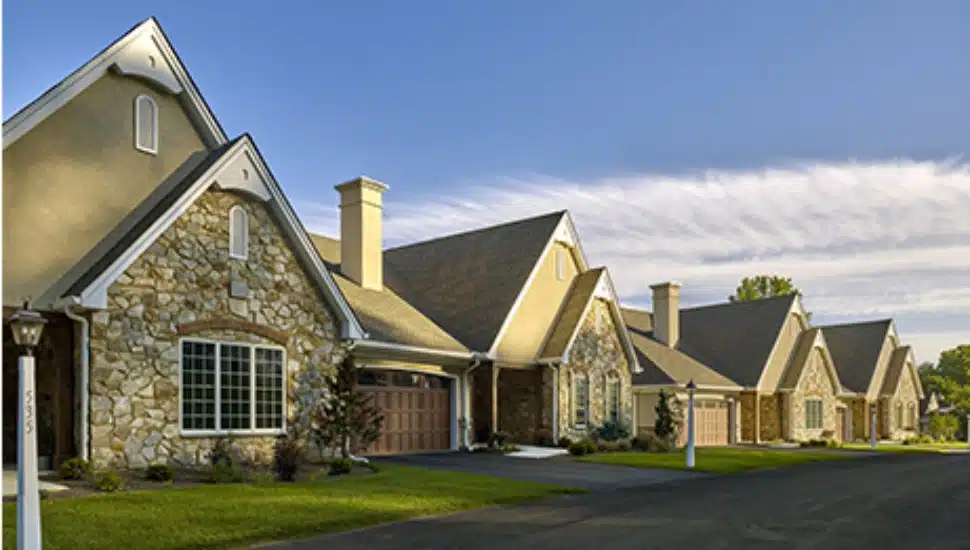

The history of Dunwoody Village in Newtown Square is closely connected to the life of William Hood Dunwoody, a Pennsylvania-born flour merchant and investor whose business career helped shape what later became General Mills.
The continuing care retirement community has equally deep roots in the land. It resides on a property that dates back more than three centuries to a quiet farm in what was then Chester County.
The Lay of the Land
The first Dunwoody ancestors settled on the property in 1712. They farmed the land for generations.
In 1842, William Dunwoody’s father, James Dunwoody, built a one-room octagonal schoolhouse free to all children living within a radius of four miles of the school.
The Octagonal school replaced a log school of the same name, built by William Dunwoody’s grandfather, Joseph Dunwoody, and two neighbors, according to the Newtown Square Historical Society website.
The Octagonal schoolhouse still stands today, and you’ll find its image on the logo for both Dunwoody Village and the municipality of Newtown Square.
A Sickly Boy With Quaker Values
William Hood Dunwoody, born March 14, 1841, grew up on that family farm and sat on those schoolhouse benches. A sickly child, he was raised in a Quaker household, in a tradition that emphasized simplicity, discipline, and service to others.
At 14, he left for an academy in Philadelphia and later spent five years learning the grain and feed trade from his Uncle Ezekiel Dunwoody.
By 23, he was running his own Philadelphia flour business, Dunwoody & Robertson.
The Move That Made Him
In 1869, William and his wife, Catherine “Kate” Dunwoody, equal in matters of business, moved to Minneapolis, Minnesota, and built their fortune.
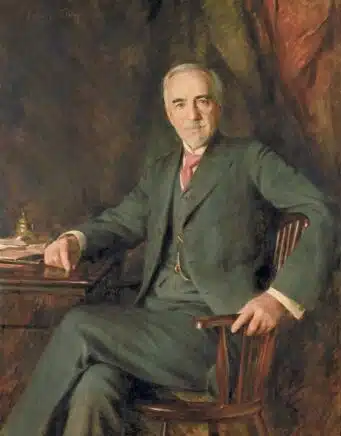
Dunwoody earned a reputation as a disciplined and highly private businessman. His firm reportedly operated under the motto “Addition, division, silence,” reflecting his preference for careful management and limited publicity.
He organized Tiffany, Dunwoody & Co., and became involved in grain merchandising, flour exports, and mill operations.
One of the most important moments in his career came in 1877, when American businessman Cadwallader Washburn sent him to England to help develop a market for flour milled from hard spring wheat grown in the American Midwest.
British bakers were initially skeptical of American flour, but Dunwoody demonstrated that Minneapolis-milled flour produced more bread per barrel than many traditional English flours.
His efforts helped establish major export markets for Minneapolis mills and contributed to the city’s emergence as the flour milling capital of the world by the end of the nineteenth century.
Dunwoody later became a silent partner in Washburn-Crosby Company, producer of Gold Medal Flour. In 1928, years after Dunwoody’s death, Washburn-Crosby became part of the newly formed General Mills.
By the early twentieth century, Dunwoody had become one of Minneapolis’s wealthiest businessmen.
He served for many years as a director and leader of Northwestern National Bank, an institution that later became part of Norwest and eventually Wells Fargo.
He Never Forgot Where He Came From
Through all of it, through the accumulation of wealth and influence, Dunwoody never forgot his roots.
Every year, he made two trips back to the family farm in Newtown Square, where relatives still lived on the property.
He bought out his brother’s interest in the land and methodically reconsolidated the farm that had been subdivided after his parents’ death.
The Secret He Kept Until the End
William Hood Dunwoody died on February 8, 1914, at age 72. When his will was read, even those closest to him were surprised.
He had left $1 million and the reconsolidated family farm in Newtown Square to build and maintain a convalescent home in honor of his parents.
The home would help sick and injured working men recover and return to their lives, in keeping with a philosophy expressed in Dunwoody’s will to prepare people for “the better performance of life’s duties.”
Dunwoody also established a governing trust to oversee the institution. After his death, his widow Kate substantially expanded the family’s philanthropic legacy through additional charitable gifts.
From Farm to Home to Village
The Dunwoody Home opened on the family farm in 1924 and served those in need for decades.
By the 1970s, advances in medicine had made the original model for Dunwoody Home obsolete.
The trustees made a decision in 1974 to open Dunwoody Village, one of the first continuing care retirement communities in the Delaware Valley.
They began with just 50 residents. Today, more than 400 people call the same 83-acre campus home — including, notably, many second-generation residents whose families chose to return.
The original Dunwoody Home was closed and eventually demolished in 1991–1992. But the trust fund William Hood Dunwoody created in 1914 continues to operate to this day.
What He Left Behind
William Hood Dunwoody’s philosophy of personal respect and dignity remains at Dunwoody Village.
As one resident who spent years researching Dunwoody’s life put it: “How he was raised here — the caring for people — is reflected in what Dunwoody Village is today.”
Find out more about Dunwoody Village and explore what it has to offer.