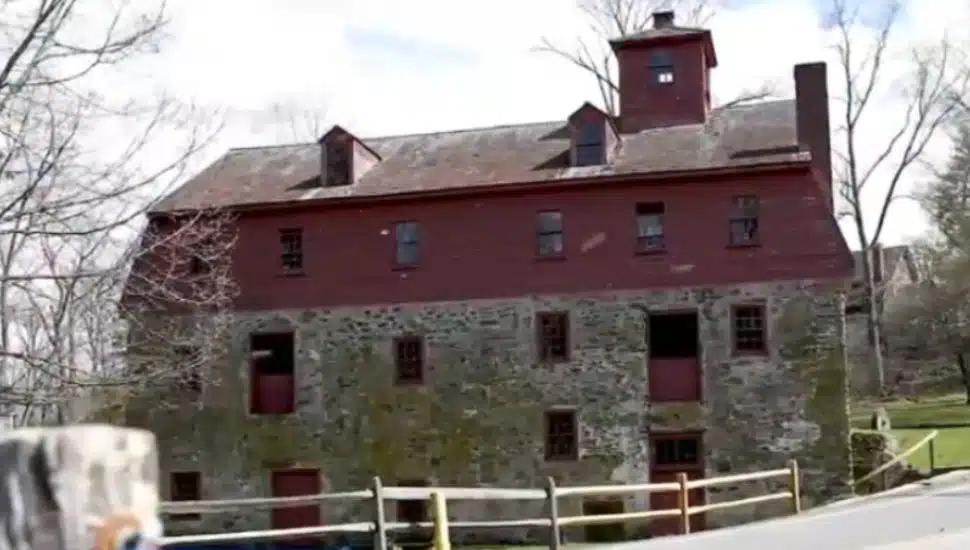


When Amy Ricci saw an opportunity to work at an actual 1704 mill and nature preserve in Glen Mills, she grabbed it.
Ricci starts as the new executive director at the Newlin Grist Mill in January.
She’s leaving her current job as executive director of Historic Rittenhouse Town, an interpretive early industrial village in Fairmount Park, once the location of America’s first paper mill.
Ricci said you can still find some residential buildings there, but the mills have been torn down, so being able to oversee an actual mill building is exciting.
“I don’t think that opportunity happens in many people’s careers, so it was something I didn’t want to pass up, and it just sounded too good to be true,” she said. “This is a big deal in the preservation world.”
The combination of Newlin’s nature preserve, interpretive mill site, and nature- and STEM-based education opportunities, “it’s just through the roof there,” she said.
Newlin Grist Mill includes a blacksmith’s shop, an 18th-century demonstration kitchen, and extensive rental facilities for weddings, retreats, and other private events, as well as restored wetlands and more than eight miles of walking trails.
Diana McCarthy, president of the Nicholas Newlin Foundation, which oversees the working 1704 watermill and its 160-acre nature preserve, said they hope to expand awareness among history buffs and nature lovers alike, and believe Ricci’s appointment is a critical step to make that happen.
“Amy’s depth of experience managing 18th-century properties and developing deep connections with the community through imaginative and appealing programming, along with her high standards in preservation practice, will serve Newlin Grist Mill well as we move into a new era of greater community engagement,” McCarthy stated in a release.
Ricci stresses the importance of preserving places like the Newlin Grist Mill as an integral part of our history.
Because it’s a working 1704 mill, there’s an opportunity to learn about the technologies that were in use then.
“You walk into an old structure and can kind of feel it, right? It’s got this living history to it. And I just think that there’s a craftsmanship that was put into these structures,” Ricci said.
Even many of the materials used to build places like the mill can’t be replicated today, so preserving them and maintaining them, learning from them is essential, she said.
Ricci has always been interested in history. She grew up in Hopewell, New Jersey, a small historic town, and her parents took them on many trips to historic sites.
“I just assumed everywhere looked like that,” she said.
Now, with the 250th anniversary of the nation being celebrated, everyone has new opportunities to experience history, including at the Newlin Grist Mill.