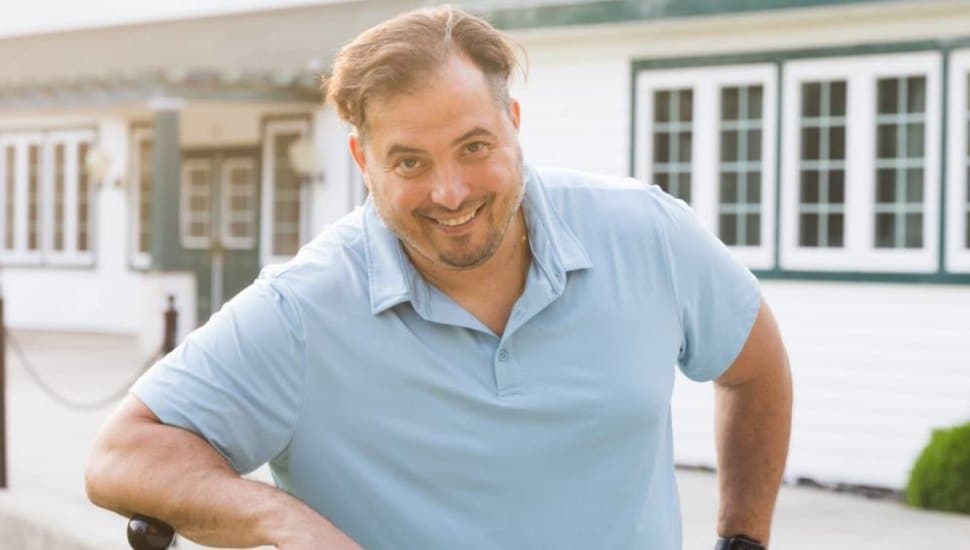


Coatesville native Marc Kramer, serial entrepreneur, teacher, and TEDx speaker, spoke with DELCO Today about growing up in the steel mill town of Coatesville, making $5,000 a year as a bookie in middle school, and struggling with his grades. After watching his father face bankruptcy in the 1970s, he resolved to work as hard as necessary to secure his future.
Thanks to a knack for both creative business ideas and follow-through, Kramer found success in a range of endeavors, including sports journalism, entrepreneurship, podcasting, and business academia.
He’s now living in Hanoi, Vietnam, teaching future entrepreneurs at VinUniversity and planning how to help the most people with his next enterprise.
Where were you born, and where did you grow up?
I was born and grew up in Coatesville. I’m a second-generation American. My father was born in Philadelphia but grew up in Coatesville.
My grandfather was Russian and served in the White Army, and he moved to the United States when he was 17. His brother had come in earlier. He went from working in the Sun Shipyard to owning a corner store luncheonette and newsstand in Coatesville, across the street from Lukens Steel Company, to opening his own drug wholesaling business.
What did your dad do?
My dad ran my grandfather’s wholesale drug business for 13 years. It went bankrupt because he didn’t know how to scale it. Big retailers were like, “I need this much product,” and my father didn’t know how to do that. Eventually, all the little guys got crushed, so if you couldn’t handle the big guys, you were done.
Then he started a medical equipment business in our dining room. Eventually, he owned his own store and building in Coatesville and had success for about 25 years. But then Ronald Reagan changed the economics of that business, and it got so bad that, when we went to the national conference at the Javits Center, nobody was there.
That was pretty much the end of people renting out hospital beds, oxygen, and everything. It was a very lucrative business until Reagan killed it.
What did your mom do?
My mom worked for Strawbridge & Clothier, first selling clothing, then as head of fine China. She was a fabulous salesperson. She’s a very young 87 now. I say she’ll outlive all this, because she doesn’t have time to die. She’s too busy.
What do you remember about growing up in Coatesville?
When I was young, Coatesville was a thriving city of 12,000 because Lukens Steel was a huge success. When they had the sidewalk sale in the summer, thousands of people came. When they had the July Fourth celebration at the football stadium, it was 10,000 people watching the fireworks. It was a typical steel town where the steel mill ran everything.
Did you ever think of working there?
No, never. I always knew, being Jewish, that I was going to college, like 98 percent of us do. In my culture, you were automatically going to college. It was Doctor first, Lawyer second, and if you weren’t very smart, you went into business. I was the first Jewish kid who didn’t graduate with honors in 100 years.
Did you play any sports when you were growing up?
I did. I played tennis. I swam for the swim team. I wanted to play football, but my parents wouldn’t allow that. I had a good rocket arm. I could throw the ball 60, 70 yards, but I was skinny, so my parents thought they were going to be peeling me off the turf.
Did you ever play for Ross Kershey at Coatesville?
I knew Ross my whole life, and lived across the street from him after I got married. When I was in high school, I started writing sports. I covered my high school football and basketball team from 1976 to 1978, and Ross was the coach. After every game, Ross would take the time to explain why he called certain plays and made certain matchups.
I appreciated his willingness to teach me, and he said I was the first sportswriter who wanted to learn and didn’t assume I knew more than he did. He was an amazing, charismatic teacher.
What kind of music did you listen to growing up?
I’m the oddball. While most kids were listening to The Rolling Stones, Led Zeppelin, and The Beatles — and don’t get me wrong, I love The Beatles — I was tuned into Frank Sinatra. There was something about the sound of his voice and the lyrics of his songs that really spoke to me. To me, he was the definition of cool.
What kind of jobs did you have in high school and college?
In middle school, I was a bookie. I was taking bets from kids in junior high to high school, and I had guys working for me. I used to watch Eliot Ness and The Untouchables. So, I was Arnold Rothstein, a notorious gambler in the early part of the last century.
In fact, I made $5,000 in one year, which wasn’t bad money back in the early ’70s. I would have made that a career, except the vice principal owed me money and threatened to suspend me if I didn’t stop. That is how I ended up being a sportswriter.
My first real job was working as a janitor for Woolworth’s during high school. I hated it. My dad wanted me to work with him, but my mom insisted on it. The good thing was that it made me resolve that I would never do that job.
Where did you end up going to college, and why there?
I scored 725 out of 1600 on the College Boards. The guidance counselor, Harry Mullen, told my father that I wasn’t college material.
But I got accepted to one school, West Virginia University, because they wanted out-of-state kids. I said, “Where the hell is West Virginia?” And my dad said, “That’s where Jerry West played.” My goal at the time was to write for Sports Illustrated. I went from being a bookie to being a prognosticator like Jimmy the Greek and then a features writer.
Was West Virginia a good choice for you?
It was the perfect choice. The people were super nice. I flunked all my first exams my freshman year, but they taught me a process for studying that I kept for the rest of my life. I graduated in four years with a 3.2 GPA.
Now I’m teaching at VinUniversity, the Harvard of Vietnam, and I taught for 10 years at Wharton in the Executive MBA program. I told my dad, “Harry Mullen must be spinning in his grave, knowing that I’m teaching the most elite students at the most prestigious business school in the world.”
My students don’t believe me when I tell them about my college board score.
How did you get into business? Who opened the door for you?
Nobody opened the door. What happened was, I loved journalism, but I was married, and we couldn’t afford to buy a house.
I worked five jobs at once to make that happen. I worked for Berkheimer Associates as a tax administrator.
I had a skill for coming up with new ideas and implementing them. I created Marc Kramer Promotions, which failed.
Sandy Schaefer, the guy who ran the Downingtown Marketplace, said, “I need a haunted house in two weeks. Can you deliver?” He told me he would pay me $5,000 for the haunted house.
So, I got five theater students from West Chester University, and I went to Downingtown Inn and told them I had 200 underprivileged kids who wanted to be ghosts. We got these old sheets and tie-dyed them, and the evening was a success.
After that experience, Sandy fired his assistant and offered me the job. I went from assistant manager to manager to CEO.
I left to start the Penn State Technology Development Center in Great Valley. I grew that from one company to 63. And then I left that to start the Eastern Technology Council. Then, I started the world’s first fully organized investor angel network in 1990.
What do you bring to the table that’s unique and distinctive, that allows you to do all these cool things?
I’m a creative problem solver. I come up with ideas like a popcorn machine, and I implement them.
I just started and ran the first high school entrepreneurship competition in Asia. And the president of the university said, “You know what I like about you? You’re always coming up with ideas and then moving forward with them, because people talk about things, but they don’t do them.”
Colleagues tell me I’ll get fired for doing stuff without telling anybody, but I’m lucky. The dean of the business school and the president like that I’m a self-starter.
Over this journey, who are the people who saw promise in you?
My Rabbi, Fred Susman, who passed over 30 years ago. When I was not doing well in high school and was getting kicked out of Hebrew school, he would come to my dad, shaking his head, and telling my dad that I had a lot of upside. He had confidence in me. He could see that I was aggressive, aspirational, and wanted to help people.
And my dad also believed in me. When I was a sportswriter for the Suburban Advertiser, a weekly paper in Exton, my dad would edit my articles and drive them to the editor. I think he spent more on gas than I got paid, which was $5 a story.
My dad was the whole difference in my life. He was always positive. He would say, “There’s always room for one more good one,” and also, “I’d rather be lucky than smart any day.” He understood that life is unpredictable, that we have very little control. I tell students all the time, “Stop putting pressure on yourself. Everything is out of your control but your effort. Just worry about your effort.”
There was also the high school journalism teacher, Ms. Ellen Darlington, who told me, “If you promise not to call me again, you can be editor of the newspaper.” Because I was chasing her every day. The principal wanted that spot to go to the valedictorian or salutatorian, but she believed I was right for it. I managed to turn the paper around from losing money for its entire existence to turning a profit.
Where does your ambition and drive come from, Marc?
Watching my father go bankrupt was a huge awakening. “I never want to be in this position. I will work as much as it takes to distance myself from that.”
I wouldn’t have been as driven if I hadn’t gone through that event with him. I’m the oldest, and my two younger sisters have no real memory of what that was. But they’re very smart. One of my sisters is the Chief Medical Officer of a big practice in Baltimore, and my other sister is head of HR for a global company. So, they’ve done well.
Here we are in 2025. What are you focused on? What are your priorities? What are you spending your time on?
My priority has always been, “How do I impact the world as a whole?” I came to Vietnam because I saw that there’s a future in entrepreneurship for them, and with my experience, energy, and willingness to start things, I can make a difference. I won a Changemaker Award and an Outstanding Faculty Award because I get up in the morning and say, “How can I change people’s lives for the positive?”
At some point, I’d like to go to Saudi Arabia and make an impact on the Middle East. I’d like to start an organization called Entrepreneurs for Peace. I believe that building a giant middle class around the world would prevent war. There would be more safety and fewer extreme positions, like right and left, like we’ve been suffering through in the United States.
America used to have a middle class. You could work for a steel mill or IBM and work a union job and have a good life. But now, my kids’ generation is living a reduced lifestyle, because we’ve had bad leadership going back to Ronald Reagan.
I voted for him twice when I was young, but now that I’m 64 years old, I realize that he was the start of the American tragedy. He brought religion in when the Founding Fathers were dead set against religion. He brought guns back in when the Founding Fathers only meant for guns to protect us against invaders. He’s the one who said there were all these criminals when there weren’t.
So, now we’re paying a huge price for leaders not being creative problem solvers and not realizing that our competitive advantage is our diversity. That foreigners come to the U.S., fall in love with our culture, education, and can-do attitude. They start companies and create great wealth and jobs, such as:
- Tony Xu (born in Nanjing, China) founded DoorDash
- Hamdi Ulukaya (Kurdish from Turkey) founded Chobani
- Jay Chaudhry (from a small village in India) founded Zscaler
- Chamath Palihapitiya (born in Sri Lanka) founded Social Capital
- Fernando Espuelas (born in Montevideo, Uruguay) founded Starmedia
What do you do with all your free time?
Work! I also love to travel. I went to 13 countries in the past two years. I feel like your mind opens up when you travel and see other cultures.
Cambodia is interesting because they have ruins that go back 1,000 years, just like Vietnam is a 1,000-year-old country. It’s been invaded a lot, but nobody ever stays. You’re not going to beat the Vietnamese. Forget it. Our guys were twice as big, we had everything going for us, and still.
The Vietnamese hold nothing against us. I thought they would be pro-China and anti-American, but they’ve been invaded by the Chinese for 1,000 years, so they’re pro-American.
I was at a leadership event with my students. They put 10 students together — five blindfolded, five not. They have to walk for two or three hours late at night through dark, heavy forest and trust each other. That showed me why they won. They work well together. They don’t give up. They’re very resilient and tough mentally, especially the women. Around 63 percent of the CEOs are women in this country.
Three last questions for you. What’s something big that you’ve changed your mind about over the last 20 years?
I was more judgmental when I was younger. Everything was black and white. And as I’ve gotten older, everything has shades of gray. So, I don’t judge anybody. As long as you’re not hurting somebody, especially children, you live your life the way you want to live it. If you’re not happy in your situation, then you should move on. Just be honest.
What keeps you hopeful and optimistic? It’s a crazy world.
The energy of young people.
There are lots of things going on that don’t make sense. However, young people are increasingly concerned about what’s happening in the world. They’re frustrated that our generation and the one after us haven’t done a good job of maintaining peace and taking care of the planet. They care about having a work-life balance because they’ve watched their parents have none.
I think the future is bright because we’re hitting rock bottom, and young people are working together to solve problems. They are working and trusting people they don’t even know. It is amazing.
Finally, Marc, what’s the best advice you’ve ever received?
My dad gave me the same advice I give kids, which is, “Just do your best every day.” It’s not that you’re not going to make mistakes, but give your best effort every day, and be authentic.
My students know they can ask me about anything — personal and professional, things I’ve messed up, whatever — and I’ll give them an honest answer. If you’re trying to hide those things, how can they trust you on the rest of it?
_______
Publisher’s Note: Helen Harris assisted with this profile.